Introduction
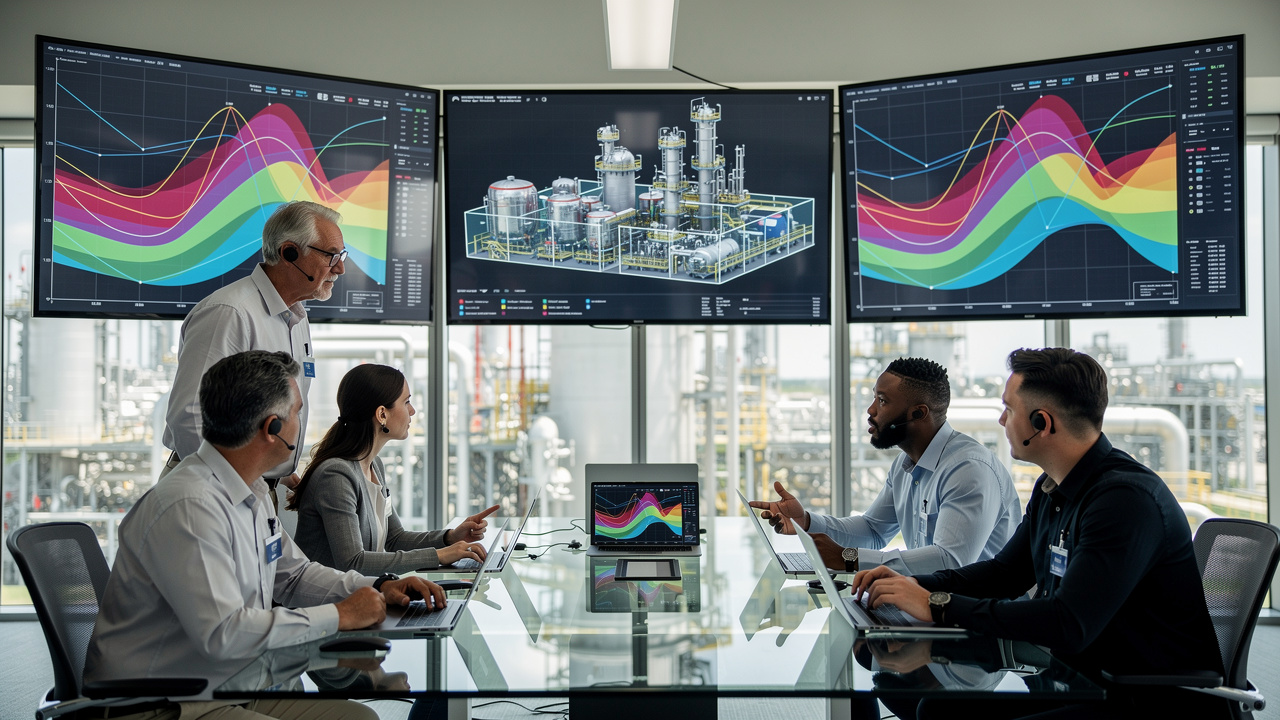
The petrochemical complex operates as a living system—veneer of routine maintenance, undercurrents of risk, and the quiet cadence of process audibles. The challenge is not merely predicting failure but orchestrating a timely, actionable response that minimizes unplanned downtime. This post presents a worked example that blends time-series forecasting across multiple horizons with physics-informed machine learning (PINN) and Neural Ordinary Differential Equations (Neural ODEs), augmented by large language model (LLM)–generated real-time action playbooks. The goal is practical: shorten downtime, reduce cost, and empower program managers with decisions grounded in rigorous technique.
Context and Objectives
Editorial direction emphasizes applied technical solutions for machine learning, with explicit attention to time-series forecasting and automation. In the petrochemical setting, the objective is to forecast equipment health and process states across near-, mid-, and long-horizon windows, and to translate forecasts into concrete, executable playbooks that operators and maintenance teams can enact immediately. This approach mirrors the S&T continuum: prototyping and experimentation that yield rapid integration of technology, while preserving the rigor required in high-consequence domains.
Problem Statement
Unplanned downtime arises from a confluence of instrument drift, catalyst aging, fouling, and control-loop instability. Traditional single-horizon models provide alerts but lack prescriptive depth. We seek a multi-horizon forecasting framework that (i) leverages physics-informed structure to respect process dynamics, (ii) captures nonlinearities and regime changes with Neural ODEs, and (iii) operationalizes forecasts through LLM-generated, real-time action playbooks that guide field staff and control room operators.
Multi-Horizon Forecasting Framework
The framework combines PINN foundations with Neural ODE representations to model process dynamics continuously in time, subject to physical constraints. Forecast horizons are segmented into:
- Near-term (0–6 hours): real-time alerts and tight control adjustments.
- Mid-term (6–48 hours): maintenance windows, spare-part planning, variability mitigation.
- Long-term (2–14 days): asset health trajectory, overhaul scheduling, risk budgeting.
The core model is a PINN that embeds physics-informed loss terms (thermodynamics, reaction kinetics, heat transfer) alongside data-driven components. This is coupled with a Neural ODE layer that evolves latent states along a continuous-time trajectory, allowing seamless interpolation between sensor timesteps and robust extrapolation during transient events.
Worked Example: Reformer Furnace Stream
Consider a reformer furnace train with multiple burner zones, catalyst sections, and heat exchangers. Sensor suites include temperatures (T), pressures (P), flow rates (F), and emissions proxies (E). The objective is to forecast tube outlet temperature T_out and furnace pressure P_f over three horizons, and to generate an actionable playbook for disturbance mitigation.
Step 1: Data assembly and feature design
- Assemble a multivariate time series: {T_i, P_i, F_i, E_i} for i in sensors, plus exogenous regressors (ambient temperature, feedstock grade).
- Augment with physics-inspired features: energy balance residuals, heater duty cycles, and known mass/energy conservation constraints.
- Normalize per equipment segment; align timestamps; handle missing data with masked training in the PINN.
Step 2: PINN–Neural ODE model
- Define latent state z(t) with dynamics dz/dt = f_theta(z, u, t) subject to physics constraints.
- Observe y(t) = h(z(t), u, t) to map latent states to measurable quantities T_out, P_f, etc.
- Loss comprises data-fit terms, physics residuals, and regularization to prevent overfitting across horizons.
Step 3: Training regimen
- Phase A: Pre-train with historical run data, emphasizing steady-state regimes.
- Phase B: Fine-tune on transient events (startups, ramping, feed changes).
- Phase C: Cross-validate horizon-specific performance and calibrate uncertainty estimates.
Actionable Forecasting Outputs
The model yields multi-horizon forecasts with associated confidence bands, plus interpretable residuals that indicate potential control or maintenance actions. Outputs are designed to be directly consumable by operators and managers.
- Near-term alerting: probability of T_out exceeding threshold within 6 hours; recommended control adjustments with tentatively safe duty limits.
- Mid-term planning: anticipated deviation magnitudes; suggested maintenance windows and spare-part implications.
- Long-term trajectory: asset-health score, predicted time-to-failure (TTF), and recommended overhaul timing.
LLM-Generated Real-Time Action Playbooks
To convert forecasts into actionable steps, we generate real-time playbooks via an LLM that consumes the multi-horizon forecast, uncertainty envelopes, and physics-consistent constraints. The playbooks are structured, auditable, and ready to deploy in control-room dashboards and mobile briefs.
Playbook contents typically include:
- Context: forecast horizon, affected units, current state summary.
- Decision levers: setpoints, flow adjustments, environmental or safety restraints.
- Recommended actions: priority order, conditional branches, and backout criteria.
- Validation steps: success criteria, monitoring metrics, and rollback procedures.
Example excerpt: “If the 6-hour T_out forecast exceeds 860°C with >90% confidence, increment preheat duty by 5%, re-evaluate after 15 minutes; if T_out reduction stalls, gradually throttle downstream flow to restore stability; if P_f shows sustained drift >2% for two consecutive checks, initiate maintenance ticket MT-042.”
Practical Implementation Notes
The following guidance aligns with a pragmatic, program-management friendly workflow.
- Data governance: ensure lineage tracking, sensor validation, and calibration logs are integrated into the training pipeline to maintain trustworthiness.
- Model governance: implement versioning, run-by-run reproducibility, and rollback capabilities for deployments.
- Computational considerations: pin the model to a streaming inference framework, enabling real-time or near-real-time forecasts with bounded latency.
- Human-in-the-loop: embed LLM playbooks within operator interfaces with clear escalation paths and auditable rationale for each recommended action.
Benefits and Metrics
The integrated PINN–Neural ODE approach harmonizes physics with data, enabling better generalization during process transients. When coupled with LLM-generated playbooks, the system converts foresight into action, reducing unplanned downtime and improving maintenance efficiency.
- Reduction in unplanned downtime by a targeted percentage based on historical baselines.
- Improved maintenance planning accuracy, lowering stockouts and overtime expenses.
- Faster response times in incident scenarios due to clear, executable playbooks.
SEO Considerations and Accessibility
This post is crafted to be search-friendly and informative for both technical leadership and program managers. Key phrases include “multi-horizon time-series forecasting,” “PINN,” “Neural ODEs,” “LLM real-time playbooks,” and “ petrochemical downtime reduction.”
Conclusion and Call to Action
The synthesis of physics-informed forecasting with machine learning and language-enabled automation delivers a disciplined path to reducing unplanned downtime in petrochemical processing. The worked example demonstrates how multi-horizon forecasts translate into prescriptive, auditable actions that operators can deploy with confidence. For organizations seeking to operationalize actionable AI in high-consequence domains, Dills Analytics LLC offers a pragmatic blueprint: prototype, validate, and integrate—then sustain with governance and continuous improvement.
If you would like a tailored pilot that demonstrates PINN–Neural ODE forecasting and LLM-generated playbooks for your assets, contact Dills Analytics LLC to begin a Rapid Prototyping engagement aligned with your near-, mid-, and long-term S&T needs.