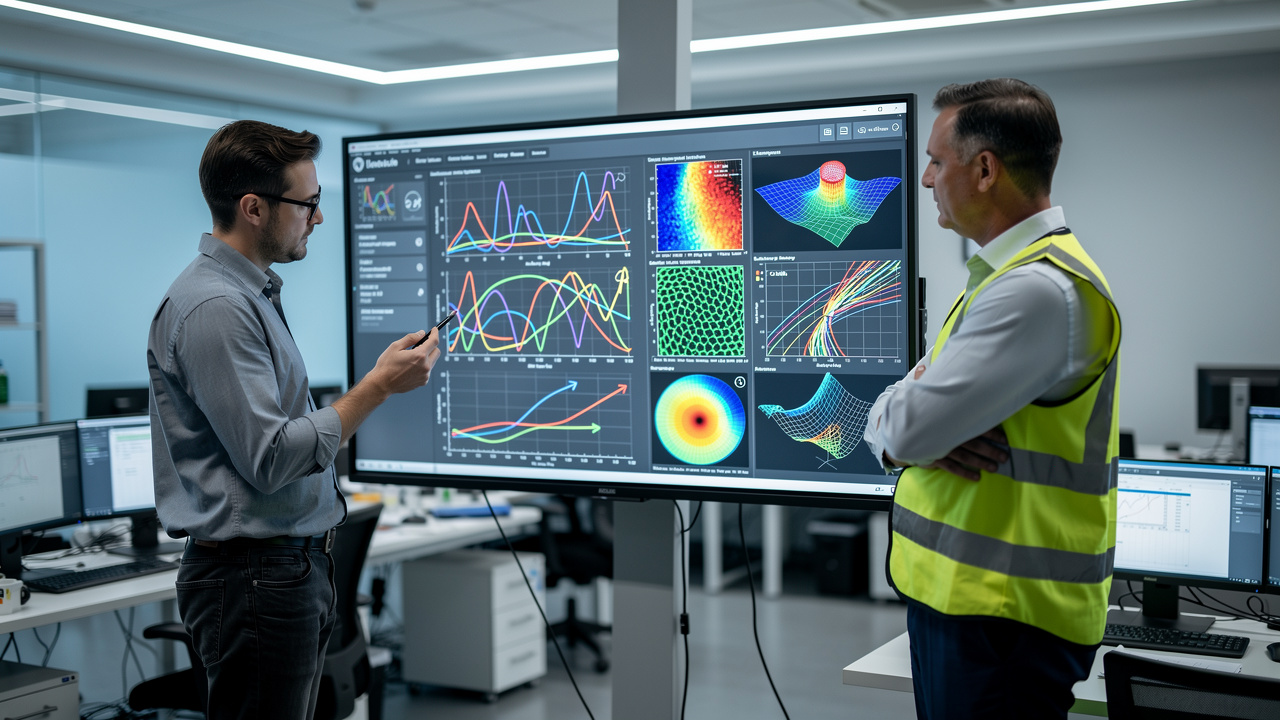
Implementing Physics-Informed Neural Networks (PINNs) for Real-Time Industrial Process Optimization: A Step-by-Step, Risk-Managed Deployment
The field of industrial process optimization demands a disciplined, theory-grounded approach that marries empirical data with the governing physics of the system. Physics-Informed Neural Networks (PINNs) offer a principled pathway to leverage both data and first-principles models, enabling real-time decision support, fault detection, and adaptive control. This post outlines a step-by-step, risk-managed deployment—aligned with an applied technical lens—so program managers can see tangible benefits while maintaining rigorous performance, reliability, and governance.
Introduction: The Need for Physics-Infused Realism
The contemporary industrial landscape requires solutions that perform under uncertainty, respect physical constraints, and adapt at the speed of modern operations. PINNs embed physical laws directly into the learning objective, reducing data hunger, improving extrapolation, and accelerating convergence. Starting from a disciplined prototyping mindset, the deployment pathway progresses from data-informed physics to real-time operation, with continuous risk assessment at each gate.
1) Define Objective, Scope, and Success Metrics
- Objective alignment: Specify the operational goals—e.g., real-time reactor temperature control, distillation column energy optimization, or batch yield maximization—while ensuring physical feasibility.
- Scope boundaries: Determine which dynamics will be modeled (partial differential equations, mass and energy balances, reaction kinetics) and which subsystems will be treated as data-driven surrogates.
- Metrics: Establish real-time latency targets, prediction accuracy within tolerance bands, safety and fault-detection thresholds, and explainability requirements.
Illustrative example: In a chemical reactor, define the goal as maintaining outlet concentration within ±2% of the setpoint, with prediction horizons of 5–15 minutes and latency under 100 ms per inference on edge hardware.
2) Assemble the Physics-Informed Model Blueprint
- Governing physics: Identify the governing equations (mass balance, energy balance, momentum, reaction kinetics) and discretize appropriately for the process scale.
- Neural architecture: Design PINN structures that reflect the physics—e.g., collocation-based residuals for PDEs, neural ODEs for dynamic systems, and shadow models for unobserved dynamics.
- Hybrid loss formulation: Combine data-driven loss (measurement error) with physics-based residuals, weighted to balance fidelity and physics adherence.
Practical tip: Start with a relatively simple reduced-order physics model to stabilize training, then progressively incorporate higher-fidelity dynamics as data and computational resources permit.
3) Data Strategy and Experimental Design
- Data inventory: Catalog process variables, sensor quality, and latent states. Ensure time alignment and label integrity for training, validation, and testing.
- Observability assessment: Identify states that can be inferred from available sensors; plan for targeted sensor augmentation if necessary.
- Active learning plan: Use experiment design to probe regions of high model uncertainty, guiding data collection during controlled perturbations or safe pilot runs.
Example: For a distillation column, collect temperature, pressure, and composition profiles under nominal operation and during controlled reflux variations to train the PINN to capture both steady-state and dynamic transients.
4) Risk-Managed Training and Validation
- Constraint enforcement: Embed safety and physical constraints in the loss (e.g., non-negativity, mass conservation); apply penalty terms for constraint violations.
- Uncertainty quantification: Employ Bayesian or ensemble methods to quantify epistemic uncertainty, guiding conservative decision-making in high-stakes regimes.
- Validation protocol: Use holdout scenarios, out-of-sample tests, and stress tests under sensor faults or actuator saturation to stress the model’s resilience.
Worked example: Train a PINN with forward physics residuals for the reactor heat transfer equation, plus a probabilistic aggregator to estimate predictive intervals under sensor dropout scenarios.
5) Real-Time Deployment Architecture
- Edge versus cloud: Decide based on latency, data privacy, and reliability requirements. On-edge inference reduces round-trip time and enhances resilience.
- Inference pipeline: Implement streaming data ingestion, normalization, and PINN evaluation with deterministic timing guarantees. Include a fail-safe path to a traditional controller if predictions drift beyond a threshold.
- Observability: Provide model health dashboards, confidence intervals, residual statistics, and alerting for anomalies, with traceability to data and model versioning.
Implementation note: Use a lightweight PINN engine for edge hardware, with model distillation to simplify the network without sacrificing critical physics fidelity.
6) Control and Optimization Integration
- Control loop design: Integrate PINN predictions into model predictive control (MPC) or rule-based supervisory logic. Ensure stability by constraining the optimization problem with physics-informed bounds.
- Optimization objectives: Prioritize process stability, energy efficiency, and yield, while respecting safety constraints and equipment limits.
- Fallback strategies: Define deterministic controllers that activate during PINN outages, with safe ramp rates and preserved process integrity.
Concrete scenario: Use a PINN-augmented MPC to anticipate outlet temperature trajectories, enabling proactive feed-forward adjustments that prevent excursions during feed disturbance events.
7) Monitoring, Maintenance, and Governance
- Model drift detection: Monitor data-model mismatch, residual patterns, and performance degradations; trigger retraining when drift indicators exceed thresholds.
- Versioning and auditability: Maintain a rigorous record of data, features, hyperparameters, and training regimes; ensure traceability for compliance purposes.
- Safety and regulatory alignment: Align with industry standards for process safety, cyber-physical security, and ontology of physical constraints.
Best practice: Establish a quarterly review cadence for model health assessments, with a staged retraining protocol that prevents abrupt shifts in control behavior.
8) Practical Worked Examples: PINN in Action
Example A — Real-Time Heat Exchanger Optimization
- Physics: 1D energy balance with convective and conductive terms, heat transfer correlations.
- PINN role: Predict outlet temperature and heat duty given inlet conditions, with collocation losses enforcing the energy equation.
- Data: Historical sensor data from 6 months, plus occasional calibrated thermocouple readings.
- Outcome: 15% reduction in energy use while maintaining outlet temperature within ±1.5°C under mobile feed conditions.
Example B — Reactor Temperature Control under Disturbances
- Physics: Mass and energy balances with first-order reaction kinetics; latent heat effects.
- PINN role: Provide fast state estimates and predictive trajectories for MPC during feedstep changes.
- Data: High-frequency temperature, pressure, and concentration measurements; simulated fault scenarios for robustness.
- Outcome: Improved disturbance rejection and 20% smoother temperature profiles during load swings.
9) SEO Heading: Risk-Balanced Value Realization
Incorporating PINNs into real-time industrial optimization yields tangible benefits when approached with disciplined risk management. The fusion of data and physics reduces data demands, enhances extrapolation reliability, and speeds decision cycles—vital in high-consequence domains. The deployment path mirrors a mature S&T process: prototype, validate, integrate, and govern, with continuous feedback loops that refine both physics fidelity and data-driven accuracy.
Conclusion: A Pragmatic, Runway-Ready Path
The step-by-step, risk-managed deployment of PINNs for real-time industrial process optimization provides a disciplined framework for executives and engineers alike. By anchoring learning to physical law, ensuring transparent validation, and embedding robust governance, organizations can achieve reliable, explainable, and high-performance AI-enabled operations. Dills Analytics LLC stands ready to translate this blueprint into executable programs—aligned with enterprise AI strategy, PINN-centered computation, and actionable, high-impact outcomes.
Call to Action: Contact Dills Analytics LLC to initiate a structured PINN readiness assessment, design a phased deployment plan, and unlock real-time optimization gains with physics-informed rigor.
